English
 Français
 Português
Overview
Making competition a driver of the common market
Established in Dakar on 10 January 1994, UEMOA set itself the primary objective of strengthening the competitiveness of its Member States’ economic and financial activities within an open and competitive market. This objective underpins every choice the Union has made in competition policy and law.
Our mission
The Competition Directorate regulates the Union’s market for goods and services by combating anti-competitive practices by undertakings and Member States, monitoring state aid and its compatibility with the common market, drafting Community competition rules and their implementing procedures, building the capacity to administer those rules and fostering a competition culture.
The Competition Directorate is responsible, in particular, for: drafting Community competition rules and implementing procedures; regulating the Union’s market for goods and services by combating anti-competitive practices by undertakings and Member States; monitoring state aid and its compatibility with the common market; upgrading the capacity to administer competition rules and developing a competition culture; promoting intellectual property.
Our vision
A common market where access remains open, where prices are set by the free interplay of supply and demand, and where the most efficient firm — not the best protected — prevails. This vision is part of the one the UEMOA Commission has set itself for 2030: “an agile institution, the driving force behind deeper integration and the structural transformation of UEMOA economies”.
Our mandate
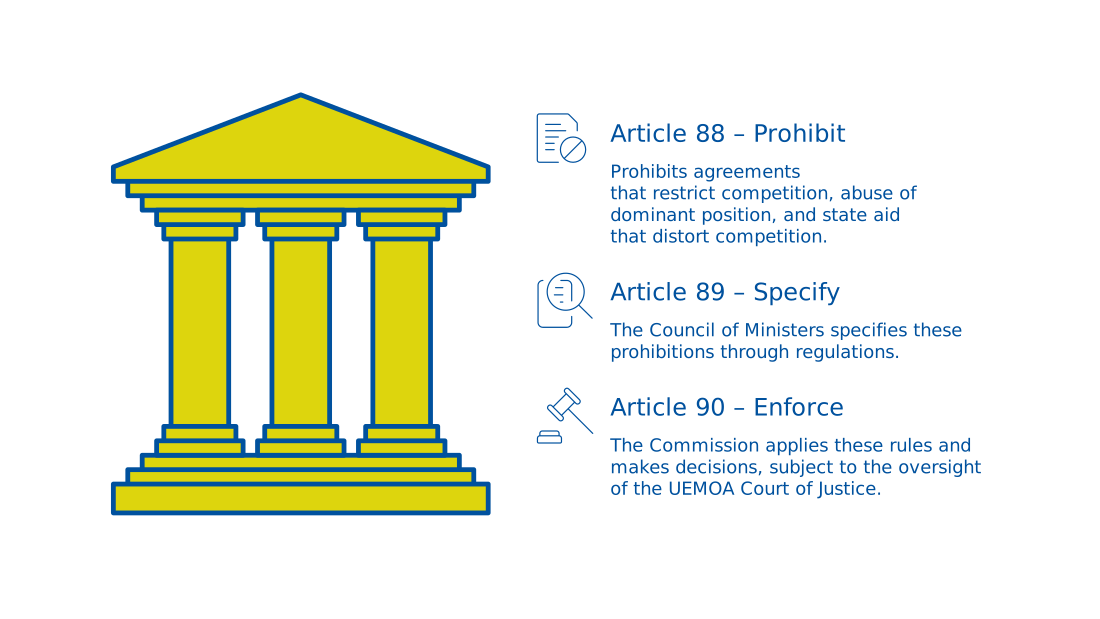
The Directorate’s mandate flows directly from the Treaty. Article 88 prohibits outright three categories of conduct: anti-competitive agreements, abuse of a dominant position and state aid that distorts competition. Article 89 empowers the Council of Ministers to specify these prohibitions by means of regulations. Article 90 entrusts the Commission, subject to review by the Court of Justice, with applying these rules and with the power to take decisions.
Exclusive competence, shared implementation
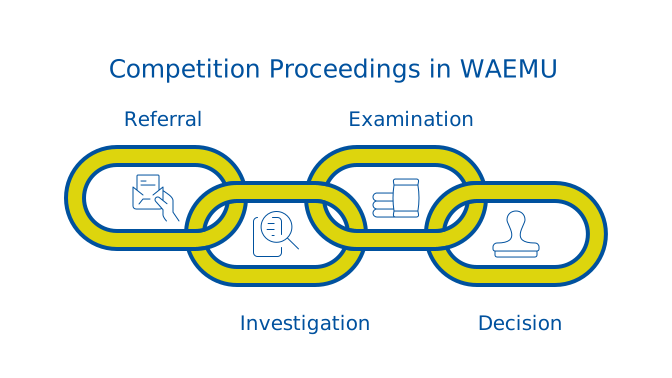
The Commission alone has competence to investigate cases and take decisions. Member States, however, through their national competition bodies, are kept informed and involved at every stage of the procedure — referral, investigation, examination, decision — and take part in decision-making within the Advisory Committee on Competition.
Our four strategic pillars
The Directorate’s work is built around four pillars that ensure a sound legal framework, rigorous market oversight and lasting cooperation, in support of an open and fair common market.
UEMOA Competition Framework
 UEMOA Competition Framework

Consolidate Community rules, draft implementing texts and ensure their uniform application across the eight Member States. Assess any draft national or Community legislation likely to affect competition within the Union.
Control of Anti-Competitive Practices
 Control of Anti-Competitive Practices
Investigate cartels and abuses of dominance, review mergers and other concentrations, conduct investigation procedures in contentious cases and penalise practices that distort the normal functioning of the common market.
State Aid Control and Market Monitoring
 State Aid Control and Market Monitoring
Assess whether state aid is compatible with the objectives of the common market, control and record it, and continuously monitor sensitive sectors to ensure fair conditions of competition between operators.
Cooperation with National Bodies and Promotion of a Competition Culture
 Cooperation with National Bodies and Promotion of a Competition Culture
Lead the network of national competition bodies, cooperate with foreign competition authorities and specialised international organisations, build stakeholders’ capacity and promote a competition culture among businesses and consumers.
A market that is still not competitive enough
The Commission’s assessment leads to a blunt conclusion: the Union’s market remains insufficiently competitive. This stems from a persistently weak competition culture and weak market regulation mechanisms, both in general and across individual value chains.
Despite an existing regulatory framework, some firms engage in practices aimed at preserving their rents; others seek to strengthen their position by using their market power to dictate how the market operates. States, for their part, tend to resort to mechanisms that shield their national companies, whether public or private. Such conduct reduces the efficiency gains that market opening can generate, holds back investment and discourages innovation.
Momentum is nonetheless building
The Commission has handled more than sixty contentious and non-contentious cases. Investigations conducted with national competition bodies, in nearly every economic sector, have led to several decisions that removed major obstacles to the proper functioning of the internal market. The average case-handling time has fallen from six years to under three.
Our strategic alignment
The Directorate’s work falls within the Commission’s 2025-2030 Strategic Plan, IMPACT 2030, and more specifically within its Axis 4 — Strengthening the foundations of integration, with a direct contribution to Axis 1 — Developing production ecosystems. With its aims of lowering costs, improving competitiveness and the quality of goods and services, and stimulating innovation, competition provides essential support for developing the production ecosystems selected in the Plan.
The PRMOC programme (2026-2030)
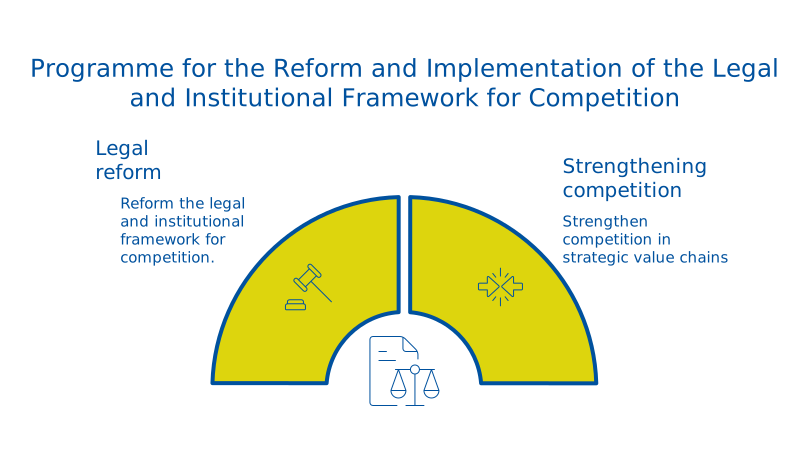
The Programme for the Reform and Implementation of the Legal and Institutional Framework for Competition (PRMOC) is the operational expression of this ambition for the 2026-2030 period. It pursues two specific objectives.
| Specific objective | Expected results |
|---|---|
| SO 1 — Reform the legal and institutional framework for competition | Substantive law reforms are completed; procedural law reforms are completed; institutional reforms are completed. |
| SO 2 — Strengthen competition in strategic value chains and on the Union’s market for goods and services | Competition referrals are dealt with; exemption measures for value-chain development are adopted; stakeholders’ capacity is strengthened; cooperation activities are carried out. |
The programme’s direct beneficiaries are the Member States (national competition bodies, the judiciary and academia), businesses and trade associations, consumer associations and the people of the Union.