English
 Français
 Português
Legal framework & instruments
The Union’s competition law, from the Treaty to implementing texts
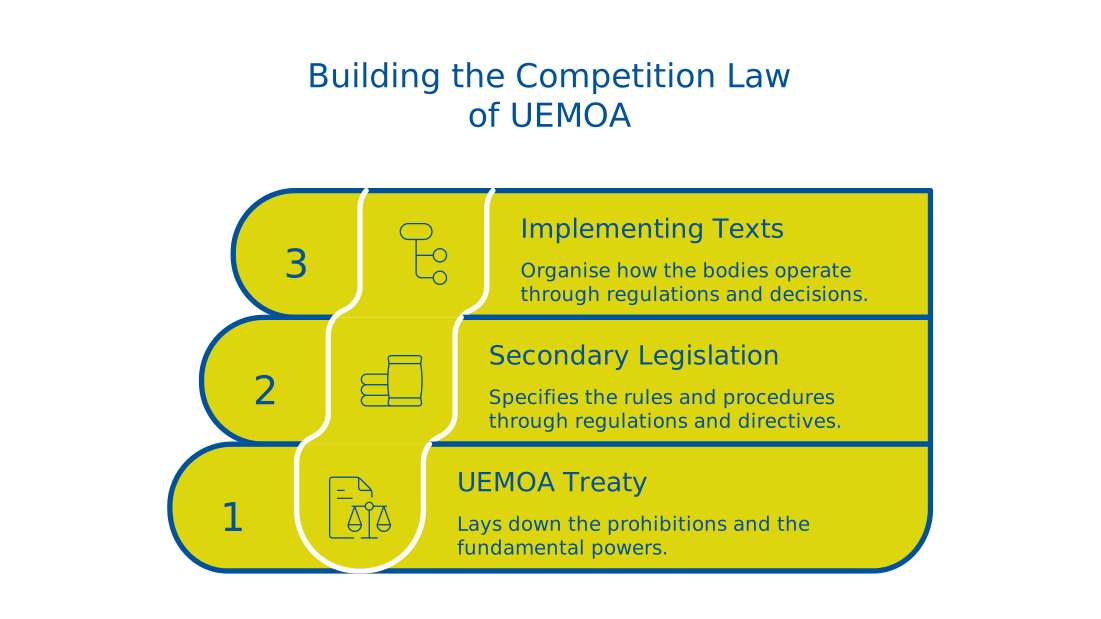
UEMOA’s Community competition law operates on three levels: the Treaty, which lays down the prohibitions and allocates powers; secondary legislation of the Council of Ministers, which specifies the substantive rules and procedures; and the Commission’s implementing texts, which organise how the advisory bodies operate.
Level 1 — The UEMOA Treaty
Three provisions of the Revised Treaty underpin the Community’s competition policy. Article 4(a) sets its purpose; Article 76(c) provides for the establishment of common rules; Articles 88 to 90 form its operational foundation.
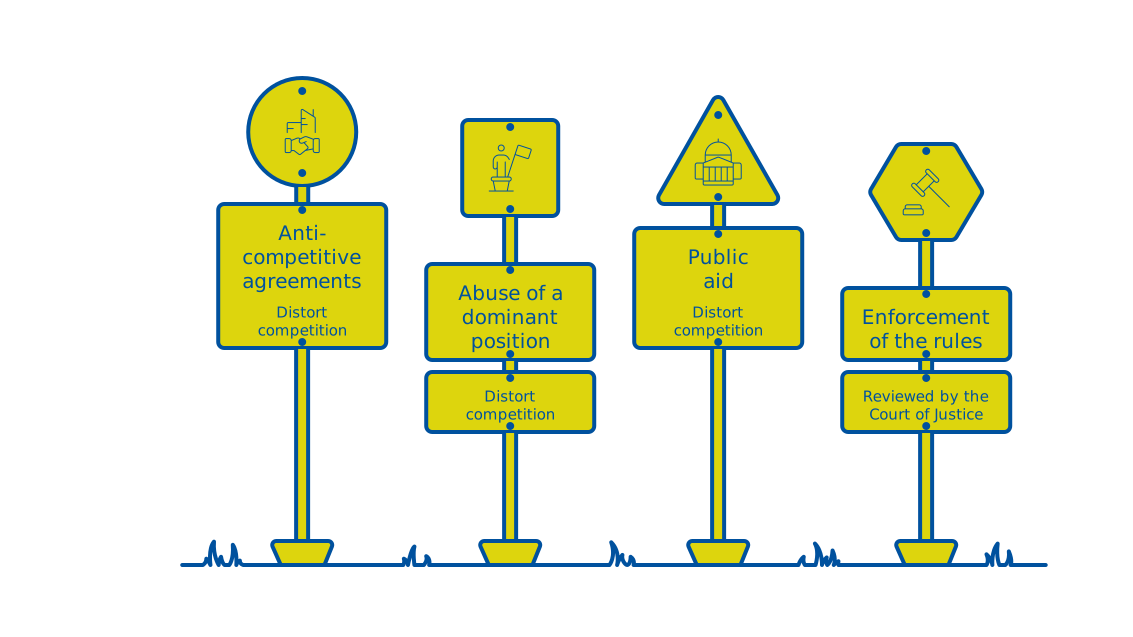
One (1) year after the entry into force of this Treaty, the following shall be prohibited as of right:
a) agreements, associations and concerted practices between undertakings whose object or effect is to restrict or distort competition within the Union;
b) any practices by one or more undertakings amounting to an abuse of a dominant position in the common market or in a significant part of it;
c) public aid likely to distort competition by favouring certain undertakings or the production of certain goods.
Article 89 empowers the Council of Ministers, acting by a two-thirds majority on a proposal from the Commission, to adopt by regulation the provisions needed to apply these prohibitions, to lay down the rules the Commission must follow as well as fines and periodic penalty payments, and to provide for limited exceptions to take account of specific situations. Article 90 entrusts the Commission, subject to review by the Court of Justice, with applying these rules and gives it the power to take decisions.
Level 2 — Secondary legislation of the Council of Ministers
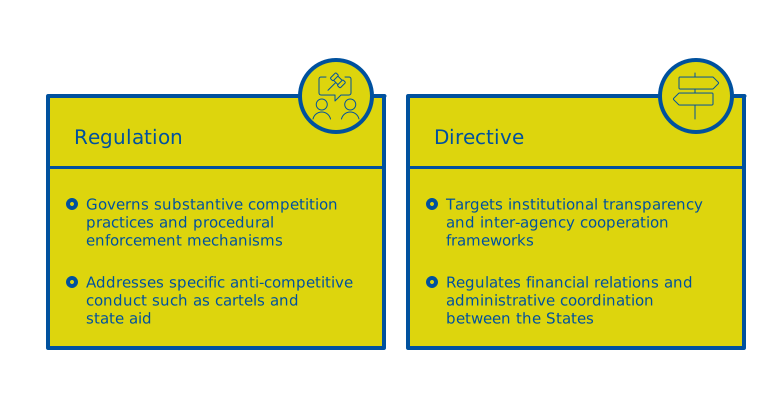
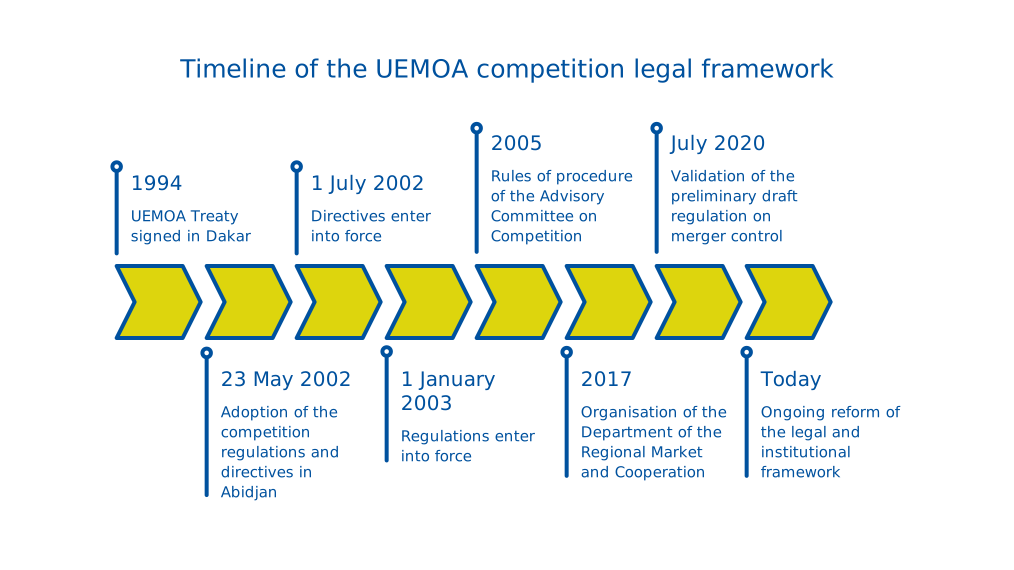
On 23 May 2002 in Abidjan, the Council of Ministers adopted three regulations and two directives that form the core of secondary competition legislation. The regulations entered into force on 1 January 2003 and the directives on 1 July 2002.
Regulation No. 02/2002/CM/UEMOA — Anti-competitive practices
This regulation defines, in Community law, the practices prohibited by Article 88 of the Treaty. It declares them prohibited without any prior decision being required, and renders the agreements and decisions concerned automatically void.
| Article | Subject | Key provisions |
|---|---|---|
| Art. 3 | Anti-competitive agreements | Agreements restricting market access; direct or indirect price fixing, including resale prices; sharing of markets or sources of supply; discrimination between trading partners; tied sales. |
| Art. 4 | Abuse of a dominant position | Unfair prices or trading conditions; limiting production, outlets or technical development; unequal conditions for equivalent transactions; tied sales. Concentrations that create or strengthen a dominant position significantly impeding effective competition are treated as an abuse. |
| Art. 5 | State aid | Aid granted by States or through State resources, in any form whatsoever, that distorts or threatens to distort competition by favouring certain undertakings or the production of certain goods is incompatible with the common market. |
| Art. 6 | Practices attributable to Member States | States refrain from any measure that would obstruct the regulation, particularly with regard to public undertakings and undertakings holding special or exclusive rights, and must not allow private undertakings to evade the constraints of the Treaty. |
| Art. 7 | Exemptions | The Commission may declare the prohibition inapplicable, individually or by category, to agreements that improve production or distribution or promote technical or economic progress, provided that users receive a fair share of the resulting benefit, the restrictions are indispensable and some residual competition is maintained. |
Key points of Article 4.3
The following constitute a concentration: a merger between two or more previously independent undertakings; the acquisition, directly or indirectly, of control of all or part of one or more undertakings, through a shareholding, purchase of assets, contract or any other means; the creation of a joint venture performing on a lasting basis all the functions of an autonomous economic entity.
Regulation No. 03/2002/CM/UEMOA — Procedures
This regulation lays down the procedures applicable to cartels and abuses of a dominant position: referral, negative clearance, notification for exemption, investigations and inspections, rights of the defence, financial penalties and periodic penalty payments. Article 28 of the regulation also establishes the Advisory Committee on Competition, which is consulted for an opinion before any decision of the Commission.
Regulation No. 04/2002/CM/UEMOA — State aid
This regulation specifies the regime for the public aid referred to in Article 88(c) of the Treaty and lays down detailed rules for its application: definition, prior notification, compatibility assessment, implementing measures and consultation of the Advisory Committee on Competition provided for in its Article 29.
Directive No. 01/2002/CM/UEMOA — Transparency of financial relations
This directive requires Member States to ensure the transparency of their financial relations with public undertakings on the one hand, and with international or foreign organisations on the other. Without such transparency, the compatibility of public aid with the common market cannot be reviewed.
What must be made transparent
- Compensation for operating losses;
- capital contributions or endowments;
- non-repayable grants or loans on preferential terms;
- forgoing profits or failing to recover debts;
- waiving a normal return on public resources;
- compensation for burdens imposed by the public authorities.
What falls outside the scope
- Services not liable to restrict competition in a significant part of the common market;
- the BCEAO and the BOAD;
- public deposits in public credit institutions on normal market terms;
- public undertakings whose turnover excluding tax did not reach one billion CFA francs in the two previous financial years — a threshold set at 10% of total assets for public credit institutions.
Data on these financial relations must remain available to the Commission for five years from the end of the financial year in which the public resources were made available. Member States must also give timely notice of their privatisation plans.
Directive No. 02/2002/CM/UEMOA — Cooperation with national bodies
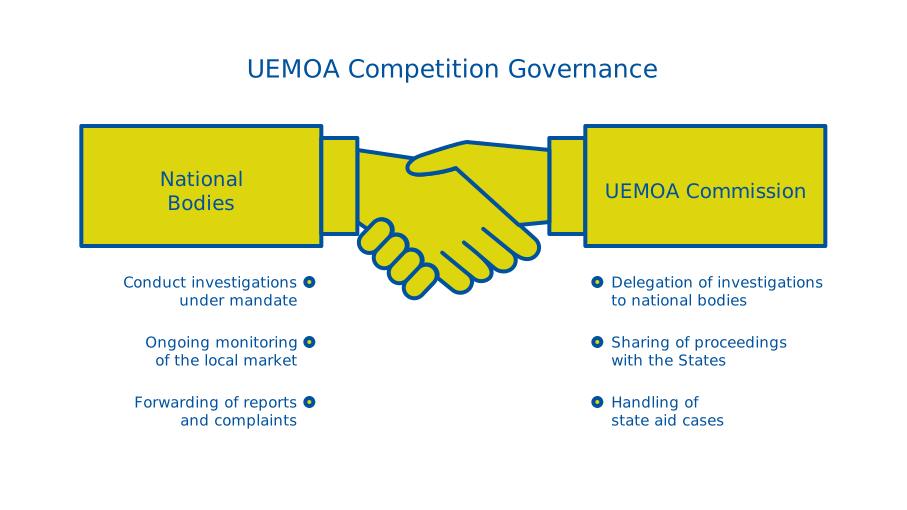
This directive sets out the respective areas of action of the Commission and the national competition bodies, and the arrangements for their cooperation. It is the cornerstone of the Union’s institutional architecture for competition.
National bodies
A general investigative mission, on national initiative or under an express mandate from the Commission, and ongoing market monitoring. In this capacity they: receive and forward applications for negative clearance, notifications for exemption and complaints; send quarterly reports on the state of competition in the sectors investigated; monitor the enforcement of decisions imposing financial obligations; record state aid; and produce an annual report on the state of competition in their country.
The Commission
Exclusive competence over state aid, anti-competitive practices attributable to Member States and practices likely to affect trade between Member States. Also exclusive competence to investigate cases and take the decisions provided for in Regulations 02, 03 and 04 of 2002. It informs national bodies of proceedings concerning undertakings located in their territory.
Level 3 — Implementing texts of the Commission
Implementing Regulation No. 007/2005/COM/UEMOA — The Advisory Committee on Competition
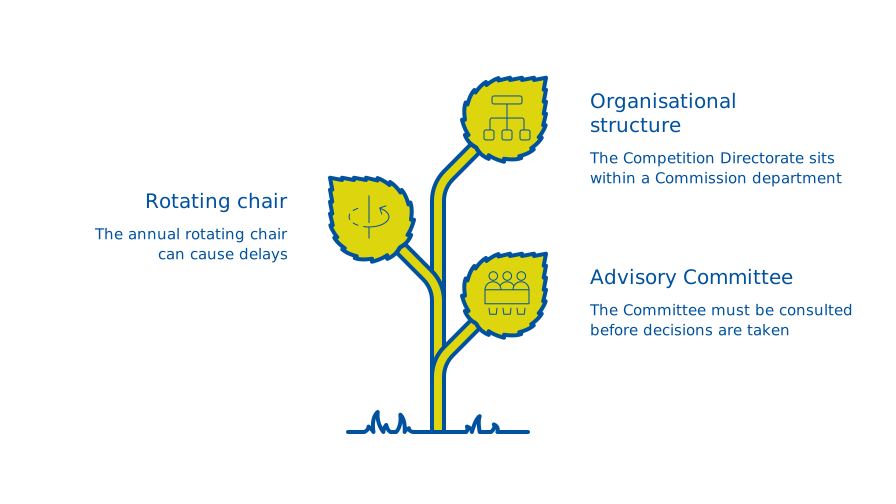
This implementing regulation lays down the rules of procedure of the Advisory Committee on Competition (CCC), the central body in the decision-making process.
Composition, chair and powers of the Committee
Composition
Sixteen members, appointed by the Member States at the rate of two per State, chosen for their expertise in competition matters and acting with full independence. Term of three years, renewable once.
Chair
A Chair appointed for one year, following the alphabetical order of the Member States, so that representatives of every State take the role in turn.
Powers
The Committee is consulted before any decision of the Commission concerning the practices referred to in Article 88 of the Treaty: negative clearances, individual or block exemptions, findings and termination of infringements, financial penalties.
When the Committee rules on a case in a sector of general economic interest, it may call on resource persons representing the national regulatory agency for the sector concerned or, failing that, the sector’s trade association; these persons do not take part in the vote. The Committee’s administrative and technical secretariat is provided by the department responsible for competition matters.
Decision No. 438/2017/PCOM/UEMOA — Organisation of the Department
This decision of the President of the Commission organises the Department of the Regional Market and Cooperation, to which the Competition Directorate belongs, and sets out the responsibilities of the Directorate and its two divisions. See the Leadership & team page
Ongoing reforms
After two decades of application, the Commission has launched a reform of the legal and institutional framework for competition. Two priorities are being pursued:
- Greater involvement of Member States in competition regulation, through a sharing of powers between the Commission and the States;
- More effective merger control, through a draft regulation introducing a threshold-based obligation to notify transactions.
These efforts take place against the backdrop of the operationalisation of the ECOWAS Regional Competition Authority (ERCA) and the adoption of the Protocol on Competition Policy of the African Continental Free Trade Area (AfCFTA).
Draft regulation on merger control
The preliminary draft text on the control of business concentrations within UEMOA was validated by representatives of the Union’s Member States following a webinar held from 27 to 29 July 2020, with the participation of UNCTAD. Until this regulation is adopted, concentrations are addressed through Article 4 of Regulation No. 02/2002, which treats them as an abuse of a dominant position where they create or strengthen a dominant position significantly impeding effective competition.
Download the legal texts
- Revised UEMOA Treaty PDF (FR) — Articles 4(a), 76(c) and 88 to 90, common competition rules
- Regulation No. 02/2002/CM/UEMOA of 23 May 2002 PDF (FR) — anti-competitive practices within UEMOA, in force since 1 January 2003
- Regulation No. 03/2002/CM/UEMOA of 23 May 2002 PDF (FR) — procedures applicable to cartels and abuses of a dominant position
- Regulation No. 04/2002/CM/UEMOA of 23 May 2002 PDF (FR) — state aid and detailed rules for applying Article 88(c) of the Treaty
- Directive No. 01/2002/CM/UEMOA of 23 May 2002 PDF (FR) — transparency of financial relations between Member States and public undertakings
- Directive No. 02/2002/CM/UEMOA of 23 May 2002 PDF (FR) — cooperation between the Commission and national competition bodies
- Implementing Regulation No. 007/2005/COM/UEMOA PDF (FR) — rules of procedure of the Advisory Committee on Competition
- Decision No. 438/2017/PCOM/UEMOA PDF (FR) — organisation of the Department of the Regional Market and Cooperation